Also, abusing a Github issue as your personal Twitter timeline is not going to persuade anyone.
The comments in that issue are atrocious.

Also, abusing a Github issue as your personal Twitter timeline is not going to persuade anyone.
The comments in that issue are atrocious.
I don’t think any of my devices are using more than 2x2 either, that is just the maximum of the access points.
The speeds I get are on a Fairphone 5 with 2x2, at most a room with drywalls away.
I get 700/500 on my Unifi U6 Enterprise (4x4 MIMO, 80 MHz, 5 GHz) and 500/500 on my Unifi AC Pro (3x3 MIMO, 80 MHz, 5 GHz).
Could probably get some more on 6 GHz but I never was able to get it to work properly.

Yes, because Docker becomes significantly more powerful once every container has a different publicly addressable IP.
Altough IPv6 support in Docker is still lacking in some areas right now, so add that to the long list of IPv6 migration todos.
There is this notion that IPv6 exposes any host directly to the internet, which is not correct. When the client IP is attacked “directly” the attacker still talks to the router responsible for your network first and foremost.
While a misconfiguration on the router is possible, the same is possible on IPv4. In fact, it’s even a “feature” in many consumer routers called “DMZ host”, which exposes all ports to a single host. Which is obviously a security nightmare in both IPv4 and IPv6.
Just as CGNAT is a thing on IPv4, you can have as many firewalls behind one another as you want. Just because the target IP always is the same does not mean it suddenly is less secure than if the IP gets “NATted” 4 times between routers. It actually makes errors more likely because diagnosing and configuring is much harder in that environment.
Unless you’re aggressively rotating through your v6 address space, you’ve now given advertisers and data brokers a pretty accurate unique identifier of you. A much more prevalent “attack” vector.
That is what the privacy extension was created for, with it enabled it rotates IP addresses pretty regularily, there are much better ways to keep track of users than their IP addresses. Many implementations of the privacy extension still have lots of issues with times that are too long or with it not even enabled by default.
Hopefully that will get better when IPv6 becomes the default after the heat death of the universe.
Will take a look at the talk once I get time, thanks. If you can find the original one you were talking about, please link.
For servers, there is some truth that the address space does not provide much benefit since the addressing of them is predictable most of the time.
However, it is a huge win in security for private internet. Thanks to the privacy extension, those IPs are not just generated completely random, they also rotate regularily.
It should not be the sole source of security but it definitely adds to it if done right.
With NAT on IPv4 I set up port forwarding at my router. Where would I set up the IPv6 equivalent?
The same thing, except for the router translating 123.123.123.123 to 192.168.0.250 it will directly route abcd:abcd::beef to abcd:abcd::beef.
Assuming you have multiple hosts in your IPv6 network you can simply add “port forwardings” for each of them. Which is another advantage for IPv6, you can port forward the same port multiple times for each of your hosts.
I guess assumptions I have at the moment are that my router is a designated appliance for networking concerns and doing all the config there makes sense, and secondly any client device to be possibly misconfigured. Or worse, it was properly configured by me but then the OS vendor pushed an update and now it’s misconfigured again.
That still holds true, the router/firewall has absolute control over what goes in and out of the network on which ports and for which hosts. I would never expose a client directly to the internet, doesn’t matter if IPv4 or IPv6. Even servers are not directly exposed, they still go through firewalls.
Anything connected to an untrusted network should have a firewall, doesn’t matter if it’s IPv4 or IPv6.
There’s functionally no difference between NAT on IPv4 or directly allowing ports on IPv6, they both are deny by default and require explicit forwarding. Subnetting is also still a thing on IPv6.
If anything, IPv6 is more secure because it’s impossible to do a full network scan. My ISP assigned 4,722,366,482,869,645,213,696 addresses just to me. Good luck finding the used ones.
With IPv4 if you spin up a new service on a common port it usually gets detected within 24h nowadays.
Off the top of my head, why did you set the prefix to 0x1? I was under the impression that it only needs to be set if there are multiple vlans
I have multiple VLANs, 0x1 is my LAN and 0x10 is my DMZ for example. I then get IP addresses abcd:abcd:a01::abcd in my LAN and abcd:abcd:a10::bcdf in my DMZ.
However, I get a /56 from my ISP wich gets subnetted into /64. I heard it’s not ideal to subnet a /64 but you might want to double check what you really got.
what are your rules for the WAN side of the firewall?
Only IPv4 + IPv6 ICMP, the normal NAT rules for IPv4 and the same rules for IPv6 but as regular rule instead of NAT rule.
My LAN interface is only getting an LLA so maybe it’s being blocked from communicating with the ISP router.
If you enable DHCPv6 in your network your firewall should be the one to hand out IP addresses, your ISP assigns your OPNsense the prefix and your OPNsense then subnets them into smaller chunks for your internal networks.
It is possible to do it without DHCPv6 but I didn’t read into it yet since DHCPv6 does exactly what I want it to do.
I’m no expert on IPv6 but here’s how I did it on my OPNsense box:
WAN interface (probably already done)LAN interface, use Track interface on IPv6, track the WAN interface and choose a prefix ID like 0x1::eeee to ::ffff, you don’t have to type the full IP)Advertisments to Managed and Priority to HighAfter that your DHCP server should serve public IPv6 addresses inside of your prefix and clients should be able to connect to the internet.
A few notes:

This seems like common sense, no?
Hindsight is 20/20. As seen in the post, there’s not that many APIs that don’t just blindly redirect HTTP to HTTPS since it’s sort of the default web server behaviour nowadays.
Probably a non-issue in most cases since the URLs are usually set by developers but of course mistakes happen and it absolutely makes sense to not redirect HTTP for APIs and even invalidate any token used over HTTP.

That website is horrible, reads like somebody having a temper tantrum.

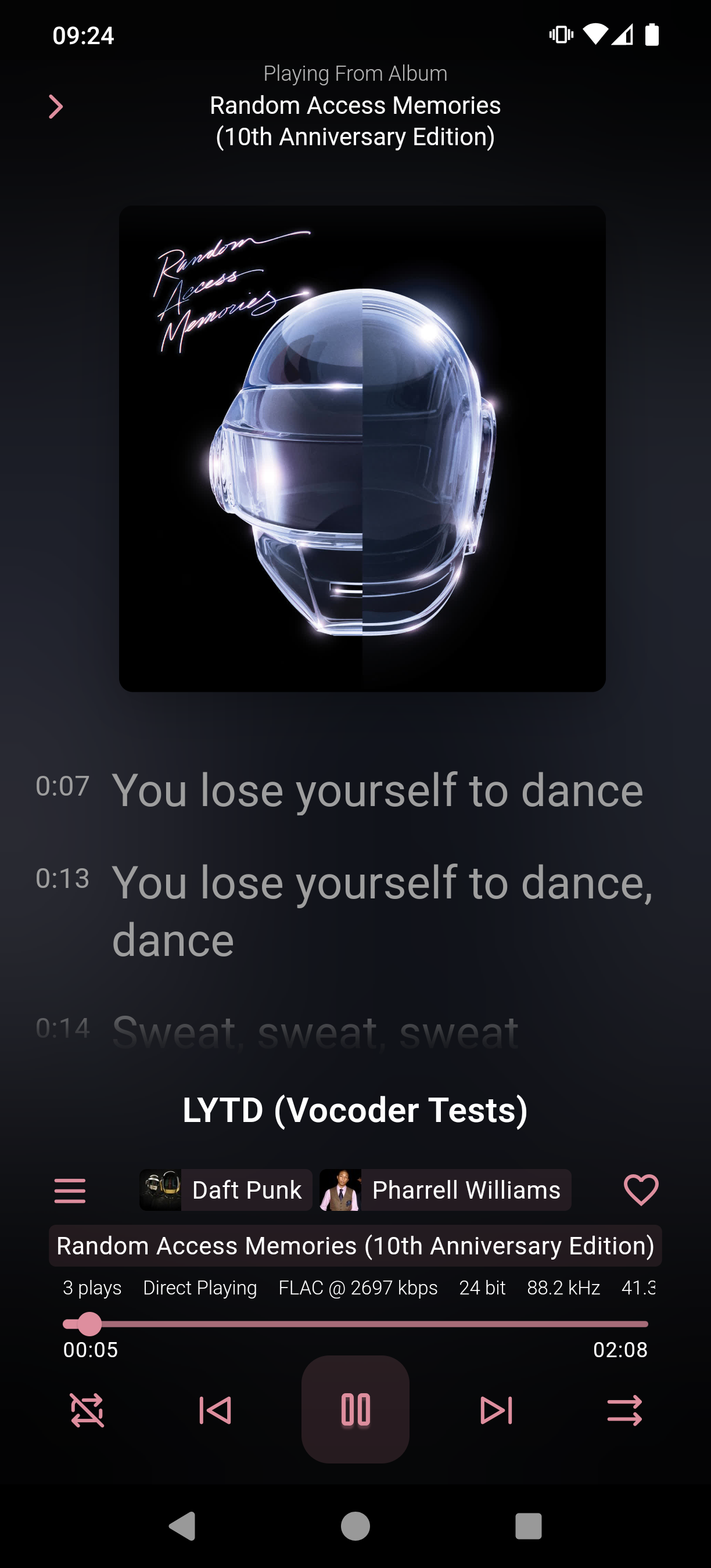
Do a library rescan on your music library and then download the latest Finamp beta from here: https://github.com/jmshrv/finamp/releases
Lyrics should work then:

That’s a shame because ionity is absolute trash.
0.69 EUR/kWh is a robbery and requiring a subscription to fill your car cheaper is a scam. They are doing it with taxpayers’ money as well.
Imagine a publicly funded gas station with those conditions and people would lose their mind.
OP didn’t ask for unpopular languages but for languages you want to be more popular.
I also want C# to be more popular, it’s a fantastic language.
Check out Picard, I switched to it when I switched to Linux: https://flathub.org/apps/org.musicbrainz.Picard
I don’t run Pi-hole but quickly peeking into the container (docker run -it --rm --entrypoint /bin/sh pihole/pihole:latest) the folder and files belong to root with the permissions being 755 for the folder and 644 for the files.
chmod 700 most likely killed Pi-hole because a service that is not running as root will be accessing those config files and you removed their read access.
Also, I’m with the guys above. Never chmod 777 anything, period. In 99.9% of cases there’s a better way.
They have a different architecture so it comes down to preference.
Docker runs a daemon that you talk to to deploy your services. podman does not have a daemon, you either directly use the podman command to deploy services or use systemd to integrate them into your system.
HTTP/3 is UDP as well but only on port 443.
Yeah, I’m also on my third controller RMA. First the stick on the left controller started drifting, then the right controller’s plastic started peeling off and finally the right controller stopped working altogether.
At least they did the third RMA for free way out of warranty.
Had to buy a new headset cable on my own though when the display started flickering after 2 years. They also sent me a new plastic clip for the cable on the back when the old one broke and a new left speaker when it started crackling instead of requiring me to send in the full headset so that’s pretty cool.